You see, the first influencer campaign may go well.
The second may take more effort.
By the third, your team might be back in spreadsheets, searching creators, negotiating rates, tracking posts, and trying to recreate what worked before.
That’s not a scaling issue.
It’s a repeatability issue.
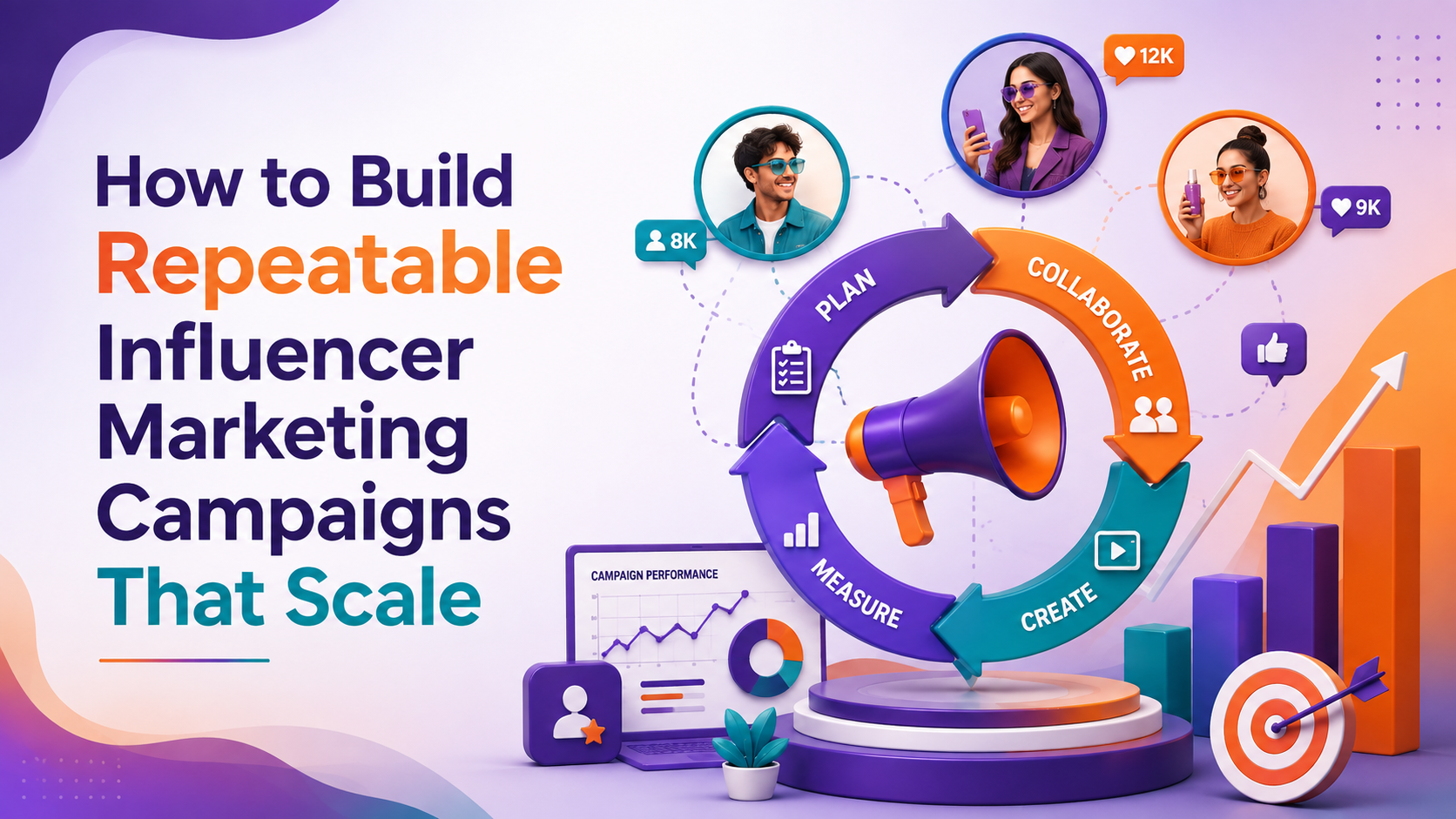
The goal isn’t just successful campaigns. It’s a repeatable system that improves every time.
1. Stop Starting From Scratch
Most teams rebuild everything for every campaign.
But your past campaigns already contain answers:
- Which creators performed best
- Which audiences converted
- Which content formats worked
- Which budgets and platforms delivered ROI
Use this data to guide the next campaign instead of restarting the process each time.
2. Build a Smarter Creator Selection Process
Don’t choose creators based only on follower count.
Evaluate:
- Audience relevance
- Engagement quality
- Content fit
- Past performance
- Reliability and cost
-> Tip: Smaller creators often outperform larger ones when the audience is more aligned.
Over time, your creator list should become more qualified, not just larger.
3. Standardize Your Campaign Workflow
Create a simple repeatable structure:
Before campaign: brief, audience, budget, creator shortlist During campaign: outreach, contracts, approvals, posting After campaign: performance tracking, ROI, learnings
This turns influencer marketing into a system, not a one-off project.
4. Track Outcomes, Not Just Metrics
Views alone don’t tell the full story.
Track:
- Sales and conversions
- Engagement quality
- Cost per result
- Creator-level performance
The goal is not reporting activity, it’s improving the next campaign.
5. Build a “Work With Again” Creator Pool
If a creator performs well, take them again.
Segment your best creators by:
- Niche
- Platform
- Audience
- Performance
- Cost
This reduces discovery time and improves consistency.
6. Turn Every Campaign Into a Learning Loop
Each campaign should improve the next:
Run → Measure → Learn → Optimize → Repeat
For example, if micro-influencers consistently drive better ROI, shift more budget toward them in future campaigns.
7. Focus on ROI, Not Reach
Reach is not the goal, results are.
Match KPIs to objectives:
- Awareness → reach, engagement
- Performance → clicks, sales, ROI
A viral campaign is not successful if it doesn’t drive business impact.
The Real Goal: A System That Improves Over Time
Scaling influencer marketing isn’t about more campaigns.
It’s about better decisions with every campaign.
When creator selection, execution, and reporting are connected, influencer marketing becomes faster, more predictable, and more effective.
That’s what scalable influencer marketing looks like.