When evaluating an influencer campaign, one question comes up again and again:
Should brands focus on engagement rate or conversion rate?
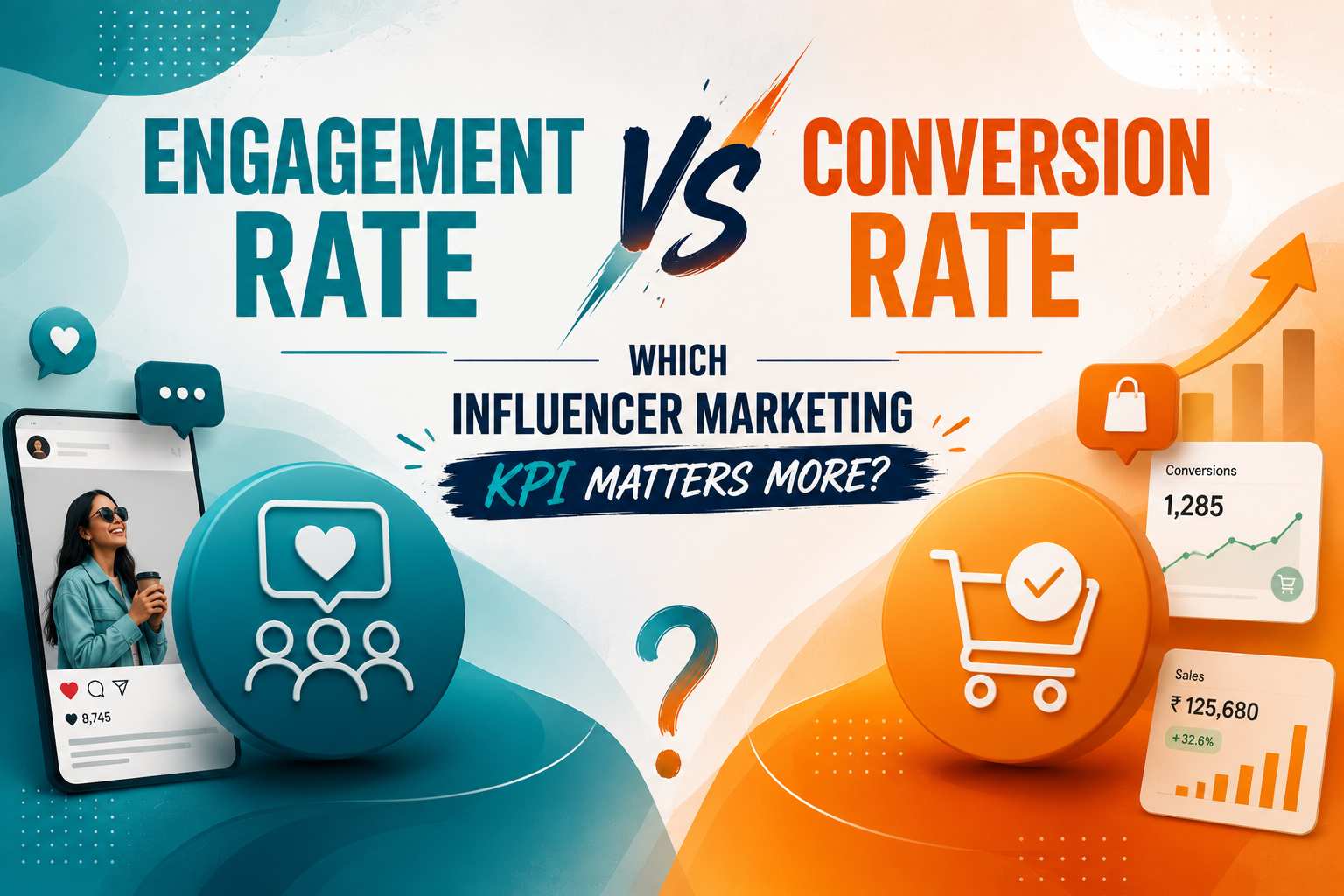
The answer is simple: both matter, but they measure different stages of the customer journey.
A creator with outstanding engagement may not generate sales, while another with lower engagement could consistently drive purchases. Knowing the difference helps brands choose the right creators and measure campaign success more accurately.
What Is Engagement Rate?
Engagement rate measures how actively an audience interacts with a creator's content.
It usually includes:
- Likes
- Comments
- Shares
- Saves
A high engagement rate often indicates that followers are interested in the creator's content and actively participate in conversations.
Brands commonly analyze engagement rate during the creator discovery stage to evaluate audience interest in the creator's content.
👉 You can give Starbuzz.ai's Free Engagement Rate Calculator to check any influencer's engagement rate in seconds.
What Is Conversion Rate?
Conversion rate measures how many people complete a desired action after seeing an influencer's content.
Depending on the campaign, a conversion could be:
- A purchase
- A website visit
- An app install
- A sign-up
- A lead submission
- An affiliate sale
Unlike engagement, conversion rate measures business results, making it one of the most valuable influencer marketing KPIs.
Engagement Rate vs Conversion Rate
Think of it this way:
Engagement Rate answers:
- Did people interact with the content?
- Did the creator capture attention?
- Was the audience interested?
Conversion Rate answers:
- Did people take action?
- Did they click?
- Did they buy?
- Did the campaign generate revenue?
Both metrics are useful. They simply measure different outcomes.
When Engagement Rate Matters More
Engagement rate is especially important when your campaign goal is:
- Brand awareness
- Community building
- Product launches
- Social proof
- Content amplification
If people aren't interacting with the content, they're less likely to remember your brand.
When Conversion Rate Matters More
If your goal is business growth, conversion rate should carry more weight.
Track conversion-focused KPIs when running:
- Ecommerce campaigns
- D2C marketing campaigns
- SaaS customer acquisition
- Affiliate marketing programs
- Creator-led commerce campaigns
These campaigns are designed to generate measurable outcomes—not just visibility.
Related reading: Creator-Led Commerce in India: How Influencers Are Becoming Sales Channels in 2026
The Best Campaigns Measure Both
The highest-performing brands don't choose one KPI over the other.
Instead, they use engagement rate to evaluate creators before the campaign and conversion rate to measure campaign performance after launch.
A simple framework looks like this:
- Before the campaign: Check engagement rate, audience demographics, and audience authenticity of the influencer.
- During the campaign: Track clicks, traffic, and creator performance.
- After the campaign: Measure conversions, sales, ROI, and creator-wise revenue.
Looking at the full picture helps brands identify creators who not only attract attention but also drive business results.
Don't Ignore ROI
Neither engagement nor conversions tell the complete story without considering campaign costs.
For example:
- Creator A delivers 500 conversions for ₹2,00,000.
- Creator B delivers 300 conversions for ₹60,000.
Although Creator A generated more conversions, Creator B may have produced a much better return on investment.
That's why brands should always calculate Influencer ROI alongside campaign KPIs.
Build a KPI Framework Instead of Tracking One Metric
Rather than focusing on a single number, track a combination of KPIs, including:
- Engagement Rate
- Conversion Rate
- Click-Through Rate (CTR)
- Cost Per Engagement (CPE)
- Cost Per Acquisition (CPA)
- Return on Investment (ROI)
- Creator-led Sales
Using multiple metrics provides a clearer picture of campaign performance.
👉 Related Reading: *Influencer Marketing KPIs in 2026: Metrics Brands Should Track
How Starbuzz.ai Helps Brands Track Influencer Marketing KPIs
Tracking campaign performance manually across multiple creators can quickly become difficult.
Starbuzz.ai helps brands monitor the KPIs that matter most.
With Starbuzz.ai, you can:
- Compare creator engagement
- Track clicks and conversions
- Measure creator-led sales
- Monitor affiliate performance
- Analyze campaign ROI
- Generate detailed influencer reports
Instead of relying on spreadsheets, marketing teams can track campaign performance from one organized dashboard.
Ready to measure influencer campaigns beyond likes and views? Sign up for Starbuzz.ai and track engagement, conversions, ROI, and creator-driven sales all in one place while running your entire campaign end-to-end within this platform.
Final Thoughts
Engagement rate gets attention. Conversion rate delivers results.
The strongest influencer marketing strategies don't rely on just one KPI. They combine engagement, conversions, and ROI to understand the complete impact of every campaign.
By tracking the right influencer marketing KPIs, brands can choose better creators, optimize campaigns faster, and invest their budgets where they generate the greatest business value.